 100% genuine goods Payment on delivery Nationwide Delivery
Hotline
(+84) 906922412
100% genuine goods Payment on delivery Nationwide Delivery

In modern central air conditioning systems, the VAV box acts as the “brain” of each thermal zone, precisely regulating airflow according to actual demand. So what is a VAV box, why is it becoming increasingly popular, and how can it be applied for maximum efficiency? This article will explain everything from A to Z.
Not everyone realizes that the cooling and heating efficiency of an HVAC system depends not only on the central air-conditioning equipment, but also significantly on terminal devices—among which the VAV box plays a critical role. Often referred to as an “intelligent throttling device,” a VAV box continuously modulates airflow to optimize indoor temperature while reducing energy consumption.
A VAV Box (Variable Air Volume Box) is a component within an HVAC (Heating, Ventilation, and Air Conditioning) system that controls the volume of conditioned air delivered to different zones or rooms within a building.
Unlike constant air volume systems, a VAV box adjusts the supplied airflow based on the specific heating or cooling demand of each zone, making it significantly more energy-efficient—especially in commercial environments such as office buildings and educational facilities.
In contrast to CAV (Constant Air Volume) systems that maintain a fixed airflow rate, VAV boxes vary the supply air volume while maintaining the desired space temperature through sensors and automatic controllers. This energy-saving solution is widely adopted in commercial buildings, offices, shopping malls, and hotels.
According to the U.S. Department of Energy, VAV systems can reduce energy consumption by up to 30% compared to CAV systems, thanks to their automatic load-based control mechanism.
VAV boxes are considered a key solution for smart buildings aiming to achieve certifications such as LEED, LOTUS, or EDGE, due to the following benefits:
Optimized energy consumption by eliminating unnecessary cooling loads
Extended service life of central equipment (AHUs, chillers) by reducing high-load operation
Lower long-term operating costs through easy integration with BMS systems
Within an HVAC system, VAV boxes are installed downstream of the main air duct, at the point where conditioned air is distributed to individual spaces.
Their primary functions include:
Automatic airflow modulation: When the zone temperature reaches the setpoint, the VAV box reduces the supply airflow to prevent energy waste
Zonal temperature optimization: Each room or zone can maintain an independent temperature setting, improving comfort and flexibility
Reduced load on central air-conditioning equipment: By balancing cooling and heating demand across zones
| Criteria | VAV Box | CAV Box |
| Airflow | Variable according to demand | Constant |
| Energy efficiency | High | Lower |
| Flexibility | Zonal control | Limited zone control |
| Initial cost | Higher | Lower |
| Applications | Offices, malls, hospitals | Warehouses, industrial facilities |
While CAV boxes are suitable for large spaces with stable load conditions, VAV boxes are the optimal choice for modern buildings that require flexibility, energy efficiency, and enhanced occupant comfort.
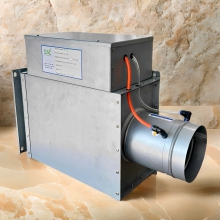
GSC VAV Boxes (Variable Air Volume Boxes) are advanced control devices used in modern HVAC and ventilation systems. In the Vietnamese market, these products are distributed by G-SORA or GSC and are considered the “heart” of HVAC systems, optimizing indoor comfort while maximizing energy efficiency.
Unlike traditional CAV systems, GSC VAV Boxes regulate the airflow supplied to each individual zone based on actual demand, while maintaining a constant supply air temperature.
Precise temperature control: Each VAV box receives signals from a room thermostat. When the room temperature deviates from the setpoint, the VAV box automatically modulates the damper to increase or decrease the supply airflow, maintaining stable and comfortable conditions.
Optimized airflow distribution: Enables independent temperature control for multiple zones using a single central AHU system.
Energy savings: By supplying only the required airflow, the system reduces AHU fan load, resulting in significant energy cost savings—especially in buildings with variable occupancy patterns.
A typical GSC VAV Box consists of the following main components:
Metal enclosure: Outer casing, usually lined with thermal and acoustic insulation
Damper: Adjustable blade that regulates the duct cross-section and airflow rate
Actuator: A small motor that receives control signals and drives damper movement
Airflow sensor and controller: Measures actual airflow and communicates with the controller or central BMS
When the desired temperature is set, the controller compares it with the actual room temperature and commands the actuator to modulate the damper accordingly—opening wider for increased cooling or closing when the zone reaches the target temperature. This ensures automatic and intelligent comfort control.
GSC VAV Boxes are widely used in commercial and high-end residential projects such as office buildings, hotels, shopping malls, and hospitals—where precise zonal temperature control and energy efficiency are critical.
Have you ever wondered why adjusting a single temperature setting automatically changes the indoor air conditions? This is made possible by the intelligent design and precise control mechanism inside a VAV box. Understanding its construction and operation allows you to fully utilize its performance.
Inlet and outlet ducts for air supplied from the AHU
Modulating damper to regulate airflow volume
Servo motor connected to the damper
Airflow and temperature sensors
Controller that processes sensor signals and commands damper operation
(Optional) Reheat coil for applications requiring air reheating
VAV boxes operate on a feedback control principle:
Room sensors measure the actual temperature
If the temperature deviates from the setpoint, the controller adjusts the damper position
Changes in airflow result in corresponding changes in space temperature
This process continuously repeats to maintain optimal thermal conditions
For pressure-independent VAV boxes, the airflow remains stable regardless of duct pressure fluctuations, thanks to integrated airflow sensors. This type is commonly used in hospitals, cleanrooms, and laboratories requiring high control accuracy.
Reducing airflow volume results in:
Lower cooling load and reduced energy consumption
Reduced fan noise
Stable pressure conditions within the main duct system
Some VAV boxes are equipped with reheat coils to warm supply air when necessary, making them suitable for cold climates or spaces requiring strict temperature stability, such as laboratories.
This is the most widely used type today. Integrated airflow sensors allow the box to maintain design airflow regardless of upstream pressure variations.
Key advantages:
Accurate airflow control
Minimal impact from AHU pressure fluctuations
Ideal for cleanrooms, hospitals, and laboratories
These units include a small centrifugal fan to assist airflow circulation, even when AHU airflow is reduced. Two configurations are available:
Parallel fan-powered VAV: Fan operates only during heating or low airflow demand
Series fan-powered VAV: Fan operates continuously for constant ventilation requirements
Designed for cold climates or zones requiring localized heating. The reheat coil is installed downstream of the damper and may be:
Electric reheat coil
Hot water reheat coil
Safety devices such as high-temperature limit relays are required to ensure safe heating operation.
Modern office buildings often feature open-plan layouts with varying occupancy levels. VAV boxes allow:
Zonal airflow adjustment
Reduced energy consumption during low occupancy
Uniform temperature and humidity control across floors
A real-world case in Ho Chi Minh City reported an 18% reduction in electricity costs after replacing CAV systems with automated VAV systems.
In healthcare environments, precise control of temperature, airflow, and pressure is mandatory. Pressure-independent VAV boxes combined with CO₂ or occupancy sensors enable:
Demand-based airflow control
Maintenance of positive or negative room pressure
Reduced risk of cross-contamination
VAV boxes contribute significantly to green building performance by:
Improving Energy Use Intensity (EUI)
Reducing chiller and AHU load
Seamless integration with Building Management Systems (BMS)
ASHRAE statistics indicate that VAV systems can reduce operational energy consumption by 15–35% compared to traditional CAV systems.
Selecting the wrong VAV box can reduce HVAC efficiency, increase noise levels, and accelerate system wear. Proper technical evaluation is essential, especially for projects requiring precise indoor climate control.
Cooling load and BTU demand per zone
Required airflow modulation range
System pressure characteristics
Heating requirements (reheat coil necessity)
These parameters are typically derived from load calculations, HVAC drawings, and owner specifications.
VAV boxes are available in sizes ranging from 150 mm to 600 mm, corresponding to different airflow capacities (CFM):
≤ 20 m²: 150–300 CFM (mini VAV)
30–50 m² meeting rooms: 350–600 CFM
Open areas > 100 m²: ≥ 1000 CFM or multiple VAV units
Noise criteria (NC) should also be considered:
Bedrooms, hospitals: NC ≤ 25
Offices: NC 30–35
Warehouses: NC 40–45
Using acoustic liners or vibration isolation helps reduce operational noise.
| Building Type | Recommended VAV Box |
| Grade A offices | Pressure-independent VAV with BMS |
| Hospitals | Fan-powered VAV with pressure sensors |
| Cleanrooms/labs | Reheat VAV with low NC |
| Shopping malls | High-capacity single-duct VAV |
| Luxury apartments | Mini VAV with balancing damper |
Early coordination with the MEP design team helps avoid costly modifications and ensures compliance with green building standards such as LEED or LOTUS.
A VAV box is an intelligent airflow control device within HVAC systems, enabling energy optimization and precise indoor climate control for individual zones. Understanding its construction, operating principles, and real-world applications allows engineers and building owners to design more efficient systems, extend equipment lifespan, and significantly reduce operating costs.