 100% genuine goods Payment on delivery Nationwide Delivery
Hotline
(+84) 906922412
100% genuine goods Payment on delivery Nationwide Delivery

Turnkey commercial kitchen exhaust treatment for restaurants, hotels and canteens: ESP electrostatic precipitators, odour control, design to commissioning per QCVN.
A kitchen exhaust treatment system is much more than an extraction fan. It is an engineering task that requires accurate calculation of airflow, static pressure and equipment capacity, through to ductwork layout and filtration technology.
Drawing on hands-on experience with many commercial kitchens in Vietnam, G-SORA delivers turnkey design, installation and operation of kitchen exhaust treatment systems that are effective, safe and compliant with environmental regulations.
Commercial kitchen exhaust contains grease, fine particulates and volatile organic compounds (VOCs). Without proper treatment, it leads to serious consequences.
Fire risk
Grease build-up inside ductwork is the leading cause of restaurant kitchen fires. When exposed to high temperatures or sparks, the risk of ignition is very high.
Health risks for kitchen staff
Smoke containing PM2.5, CO and VOCs irritates the respiratory system and can lead to chronic illness over time.
Pollution and neighbour complaints
Cooking odours spreading into residential areas trigger complaints and directly affect business.
Risk of administrative penalties
Food-service businesses must meet environmental standards such as QCVN 19:2009/BTNMT and related regulations. Violations can result in heavy fines or suspension of operations.
These issues cannot be solved with stand-alone fixes. They require a complete treatment system, properly designed from the start.
Customised solutions
G-SORA does not apply a one-size-fits-all formula. We survey and measure the floor area, number of cooking stations and cooking intensity to calculate the airflow (m³/h), fan capacity and optimal duct layout – balancing filtration efficiency against energy costs.
Cost balance
An optimised duct layout reduces pressure losses and saves operating energy for the owner.
A compliant commercial kitchen exhaust system typically combines several stages working together:
Exhaust ductwork – designed to minimise pressure loss and limit grease accumulation.
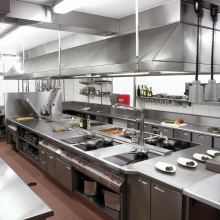
Stainless steel kitchen hood – captures smoke at the source and traps coarse grease before it reaches the duct.
ESP electrostatic precipitator – removes grease particles and PM2.5 with up to 95–99% efficiency, the key stage for meeting emission limits.
Odour control unit (activated carbon / controlled ozone) – breaks down odour-causing VOCs before discharge.
Industrial centrifugal exhaust fan – maintains stable negative pressure and continuous airflow throughout the system.
All equipment is sized and installed to a single overall design, never as disconnected parts.
G-SORA's technical team installs to the approved drawings, ensuring a neat finish and safety:
On completion, exhaust emissions are measured to confirm compliance with QCVN 19:2009/BTNMT and current environmental standards before handover.
Regular maintenance keeps the system at peak performance, extends equipment life and prevents breakdowns. Our technicians respond quickly to service requests.
Proper maintenance reduces fire risk and extends equipment life.
1. Site survey – our engineers measure the site, assess existing conditions and determine cooking intensity, kitchen layout and discharge requirements.
2. 2D/3D system design – detailed calculation of airflow (m³/h), fan capacity and duct layout, with equipment selection.
3. Transparent quotation – itemised equipment and installation costs, with no hidden extras.
4. Installation – carried out to the approved design, on schedule and safely.
5. Testing and handover – emissions measured to QCVN 19:2009/BTNMT before handing over technical documents and operating instructions.
A healthier workplace – grease smoke contains PM2.5, CO and VOCs that cause respiratory illness with long exposure. A well-ventilated kitchen improves productivity and reduces occupational health risks.
Regulatory compliance – food-service businesses must keep kitchen emissions within QCVN 19:2009/BTNMT. A compliant system avoids legal risk and keeps operations running.
Lower fire risk – grease in ductwork is highly flammable. Proper design, installation and maintenance limit grease build-up, the main cause of kitchen fires.
Lower operating costs – a correctly calculated system reduces energy consumption and maintenance costs.
Food hygiene – a poorly designed system lets condensed grease drip from ducts onto food preparation areas.
A site survey allows us to propose the most cost-effective solution.
1. Wrong airflow design – weak extraction and incomplete smoke treatment.
2. Incomplete systems – installing only an exhaust fan without filtration fails environmental standards.
3. Poor duct design – high pressure losses, higher energy use and lower performance.
4. No scheduled maintenance – grease build-up reduces performance and increases fire risk.
Each type of operation receives a tailored design for optimal performance.
If you are opening a restaurant, renovating a kitchen or upgrading an existing exhaust system, investing correctly from the start saves money in the long run.
G-SORA is ready to survey your site and recommend the right solution for your business. Call 0866016027.
G-SORA – Create Sustainable Life