 100% genuine goods Payment on delivery Nationwide Delivery
Hotline
(+84) 906922412
100% genuine goods Payment on delivery Nationwide Delivery

Quick answer: The difference between a CAV box and a VAV box is simple: a CAV box holds one fixed airflow, while a VAV box raises or lowers airflow automatically according to room temperature. Fresh air, exhaust and zones with steady loads should use CAV. Offices, hotels and shops, where the load changes through the day, should use VAV. G-SORA is the official distributor of GSC CAV/VAV boxes in Vietnam, with stock in Ho Chi Minh City, Da Nang and Hanoi.
Not sure whether to choose CAV or VAV, which size, or what it costs? G-SORA replies the same day.
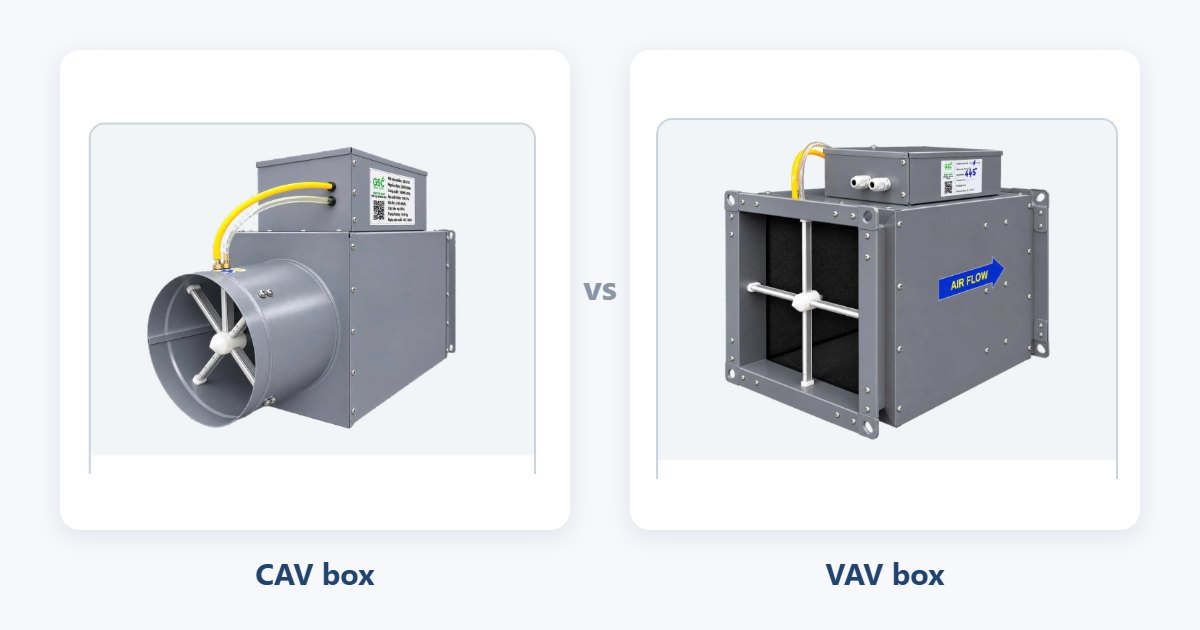
Both are terminal units installed on the supply duct, upstream of the diffusers. Inside each one there is a damper, an airflow sensor and a controller with a built-in actuator. The only difference is the airflow value the controller follows:
Both types are pressure independent: the airflow delivered to the room does not drift when duct pressure changes. That is what separates them from a manual volume control damper (VCD), which only fixes the blade position.
| Criteria | CAV box | VAV box |
|---|---|---|
| Airflow | Fixed at the set value | Varies between Vmin and Vmax |
| Control signal | No thermostat needed | Thermostat or CO₂ sensor |
| AHU fan energy savings | Almost none | Yes, when the AHU has a variable speed drive |
| Equipment cost | Lower | Higher (adds a thermostat, can connect to BMS) |
| Typical areas | Fresh air, toilet and kitchen exhaust, plant rooms, corridors | Offices, hotels, retail, schools, hospitals |
According to the GSC VAV/CAV catalogue 2026, a VAV box has three modes, shown in the chart below:
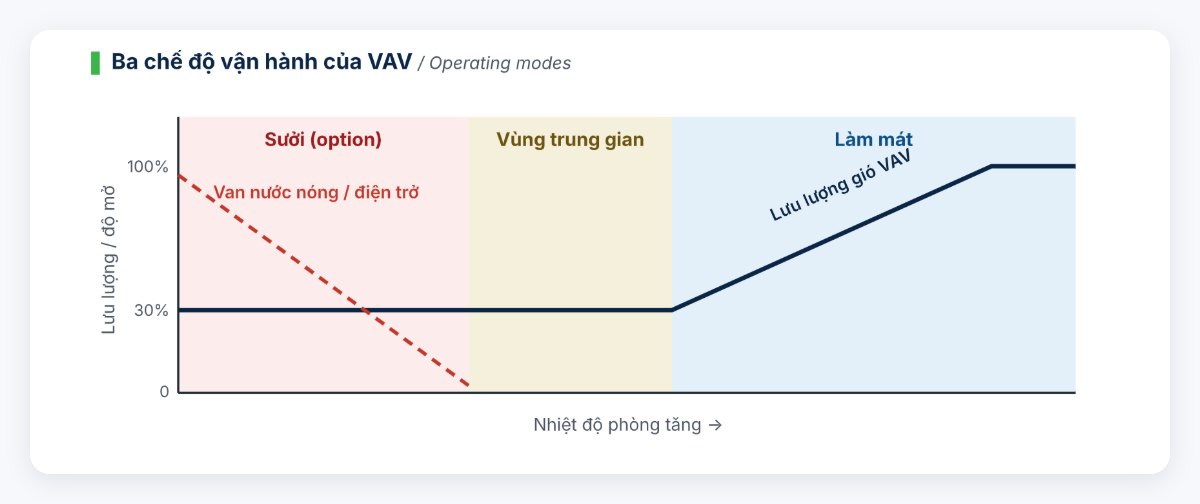
A CAV box has none of these modes. It only holds one airflow point, which is why the GSC catalogue states that CAV boxes are supplied without a thermostat.
| Area | Choose | Why |
|---|---|---|
| Offices, hotel rooms, shops | VAV | Heat load changes with time and occupancy, so fan energy savings are largest |
| Fresh air supply per floor | CAV | The design fresh air rate must be held exactly |
| Toilet, kitchen and plant room exhaust | CAV | Exhaust airflow must stay steady regardless of temperature |
| Lobbies and corridors with steady loads | CAV (or VAV if there is a BMS) | The load barely changes, so VAV adds little |
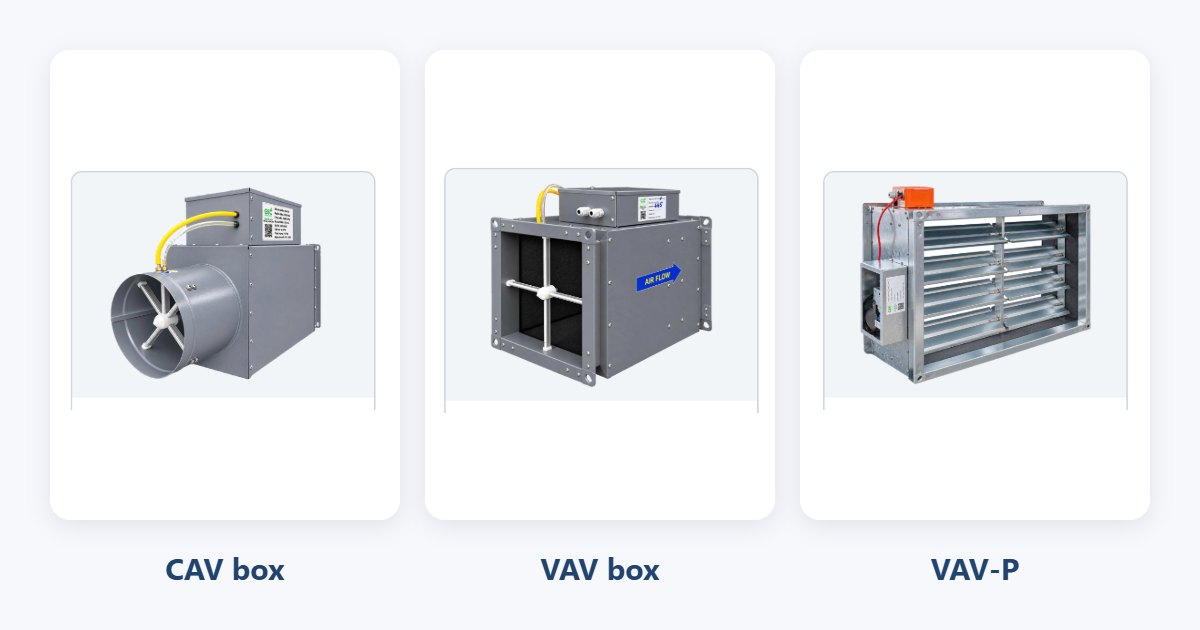
| Rooms that must stay at positive or negative pressure | Room pressure VAV (GSC-VAV-P) | Controlled by room pressure, not temperature |
In practice most buildings use both: VAV for conditioned zones, CAV for fresh air and exhaust. Note that VAV only saves energy when the AHU fan has a variable speed drive and slows down according to duct pressure. If the fan runs at a fixed speed, most of the benefit is lost.
The figures below are an illustration only; replace them with your project data. Suppose an office zone needs a maximum airflow of 2,000 m³/h and a minimum of 600 m³/h, using a rectangular VAV box.
Rule of thumb: choose a size where the zone Vmax falls between 70% and 100% of Fmax and Vmin is no lower than 20% of Fmax. The result should be confirmed by the design engineer at a working static pressure of 50–250 Pa.
Does a CAV box need a thermostat?
No. A CAV box only holds a fixed airflow, so it comes without a thermostat.
Can a CAV box be converted to VAV after installation?
The dimensions follow the same size table, but you need to add a thermostat, reconfigure the controller and check the AHU fan logic. Send the case to G-SORA to check.
Can a VAV box run as a CAV box?
Yes, by setting Vmin equal to Vmax. Still, choosing the right type from the start is simpler and cheaper.
How do CAV/VAV boxes differ from a manual volume control damper (VCD)?
A VCD only fixes the blade position, so airflow still drifts when duct pressure changes. CAV/VAV boxes measure the actual airflow and compensate automatically.
G-SORA is the official distributor of GSC VAV boxes, CAV boxes and VAV-P units, with stock in Ho Chi Minh City, Da Nang and Hanoi. Send us the airflow schedule for each zone or your BOQ, and G-SORA will recommend CAV or VAV for each area, select sizes and quote the same day.
Send your airflow schedule or BOQ for a same-day quote on GSC CAV/VAV boxes
See GSC Single Duct VAV Box · Download the GSC VAV/CAV catalogue 2026 (PDF)