 100% genuine goods Payment on delivery Nationwide Delivery
Hotline
(+84) 906922412
100% genuine goods Payment on delivery Nationwide Delivery

Description:
Even air distribution, minimizing hot and cold spots
Precise airflow direction control, easy to adjust
High aesthetic design, ideal for stepped or recessed ceilings
Effective noise reduction, smooth and quiet operation
Easy cleaning, less dust accumulation compared to grille diffusers
Optional custom color coating to match interior finishes
Compatible with OBD dampers and acoustic attenuation systems
Parameter:
| Product code | G-MG03 |
| Product model | G-MG03 |
| Frame Thickness | 0.8 - 1.2 mm |
| Blade Thickness | 0.5 - 1.0 mm |
| Effective area | 50 - 70% |
Frame thickness: 0.8 mm – 1.2 mm
Ensures sufficient rigidity for long-term installation and operation.
Air blade thickness: 0.5 mm – 1.0 mm
Provides flexible airflow adjustment while maintaining stability under high airflow conditions.
According to HVAC design standards, linear slot diffusers typically achieve an effective area of 50%–70% of the total installation cross-section. This results in:
Uniform air distribution without airflow loss through inactive areas
Optimized air pressure, contributing to reduced energy consumption for fans and air-conditioning systems
Airflow capacity:
Typically ranges from 150 to 500 m³/h, depending on:
Number of slots (1, 2, 3 slots, or more)
Diffuser length
Internal blade configuration
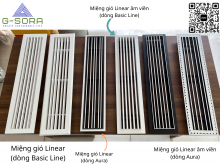
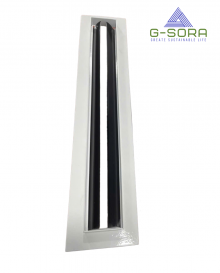
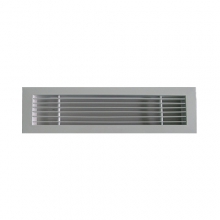
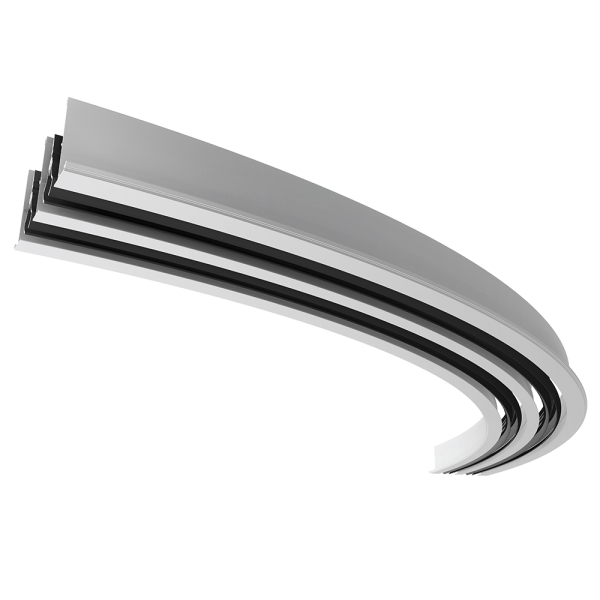
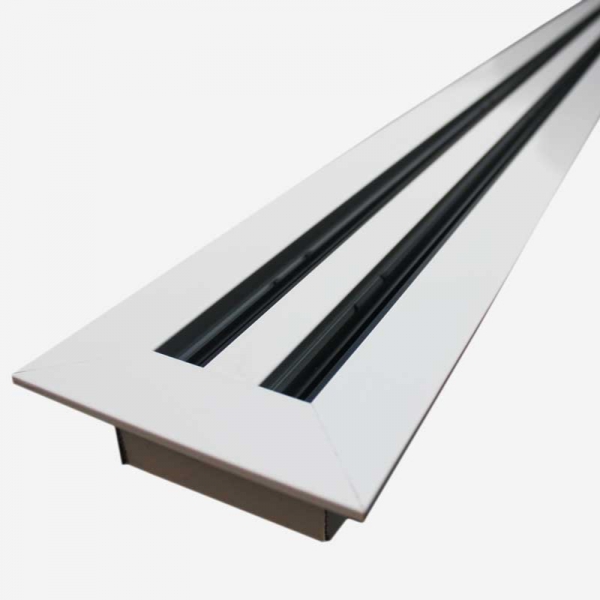
A linear slot diffuser consists of three main components:
Outer frame:
Defines the overall structure, commonly made from extruded aluminum A6063-T5 or stainless steel.
Frame thickness: 0.8 – 1.2 mm, providing rigidity while remaining lightweight for easy installation.
Air blades:
The key component for airflow direction control.
Typically designed with a triangular profile to enhance aerodynamic performance and maintain quiet operation.
Blade thickness: 0.5 – 1.0 mm.
Air slots:
Narrow, elongated openings that enable smooth and uniform airflow distribution.
Available in 1-slot, 2-slot, 3-slot configurations, or modular combinations depending on space and airflow requirements.
Commonly used materials include:
Extruded aluminum: Lightweight, durable, and resistant to oxidation in humid environments
Stainless steel: Used in industrial or special environments requiring enhanced corrosion resistance
Surface finishing is typically white powder coating, which:
Reduces dust adhesion
Simplifies cleaning and maintenance
Matches standard ceiling finishes
Custom color coating is also available to ensure full integration with interior design concepts.
One of the advantages of linear slot diffusers is their flexibility in accessory integration, most notably:
OBD (Opposed Blade Damper):
Installed behind the diffuser to regulate airflow volume and facilitate HVAC system balancing.
Modular connection joints:
Enable multiple diffusers to be joined into a continuous linear run, ideal for corridors or large open spaces while maintaining a seamless aesthetic.
Beyond technical performance, linear slot diffusers are highly valued for their versatility across various building types:
Office buildings:
Provide even air distribution with low noise, ideal for focused working environments.
Hotels and resorts:
Offer superior comfort through adjustable airflow and refined, unobtrusive design.
Shopping malls and showrooms:
Meet high aesthetic demands, require minimal maintenance, and occupy minimal visual space.
Hospitals and clean rooms:
Precise airflow control supports environmental quality and indoor air standards.
A key advantage across these applications is the ability to flexibly serve both supply and return air, which many conventional diffusers cannot achieve effectively.
Key factors to consider include:
Room area and ceiling height:
Larger spaces require longer diffusers or multiple slots for even air distribution.
Required airflow rate:
Calculated according to HVAC standards (CFM or m³/h).
Installation type:
Recessed ceiling, exposed ceiling, or wall-mounted installation determines flange and airflow direction selection.
Aesthetic requirements:
Frame thickness, finish color, and visibility must align with interior design.
Important questions before selection:
Is the diffuser for supply air or return air?
Is there an existing recessed ceiling opening?
Is an OBD damper required for airflow balancing?
Prepare ceiling opening according to diffuser dimensions
Install mounting frame and secure using screws or brackets
Use rubber gaskets or vibration-isolating materials to minimize noise
Commonly used for return air
Ensure precise alignment with duct connections to prevent air leakage
Practical Tips:
Always check system pressure balance after installation to avoid backflow
Avoid reversing supply and return diffuser orientation, as slot designs may differ slightly
Use manufacturer-approved modular connectors for extended linear runs
Apply technical sealant or silicone at joints to prevent air leakage
Use rubber washers or vibration dampers at fixing points to avoid long-term noise issues
Avoid installing near high-powered fan inlets unless acoustic attenuation is provided
For long-term performance, maintenance every 3–6 months is recommended:
Carefully remove the frame and blades using a screwdriver
Clean surfaces with a soft cloth; avoid aggressive cleaning agents
Inspect blades for misalignment or stiffness
Reinstall components correctly and verify blade movement
For units with OBD dampers, recheck damper settings to maintain airflow balance
The adjustable linear slot air diffuser is an optimal solution for projects requiring stable airflow distribution, precise directional control, and high aesthetic standards. With modern slot design, durable materials, and extensive customization options, it is increasingly adopted across residential, commercial, and institutional buildings. Proper selection, correct installation, and regular maintenance are essential to ensure long-term efficiency and performance.