 100% genuine goods Payment on delivery Nationwide Delivery
Hotline
(+84) 906922412
100% genuine goods Payment on delivery Nationwide Delivery

Description:
Automatic control, precise opening/closing based on signal
Energy saving, reduces HVAC operating costs
Suitable for both round and rectangular duct systems
BMS compatible, allows flexible remote control
Durable construction with high-quality electric actuator
Quick installation, easy operation and maintenance
Improves air-conditioning efficiency, balances air pressure
Meets safety standards for modern buildings
Wide applications: factories, office buildings, shopping malls
Parameter:
| Product code | G-MDT |
Basic Construction of Motorized Control Damper
A motorized control damper typically consists of the following main components:
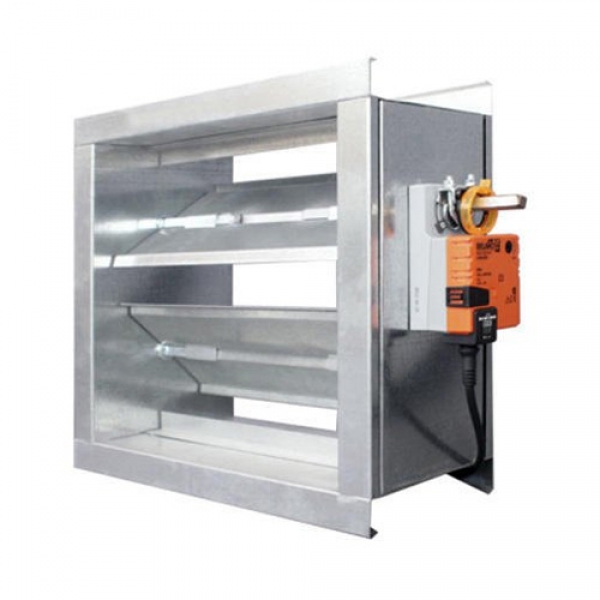
Damper frame: Made of galvanized steel or stainless steel, providing structural support and guiding the airflow.
Damper blades: Round or rectangular blades mounted on a shaft to regulate the opening angle and airflow.
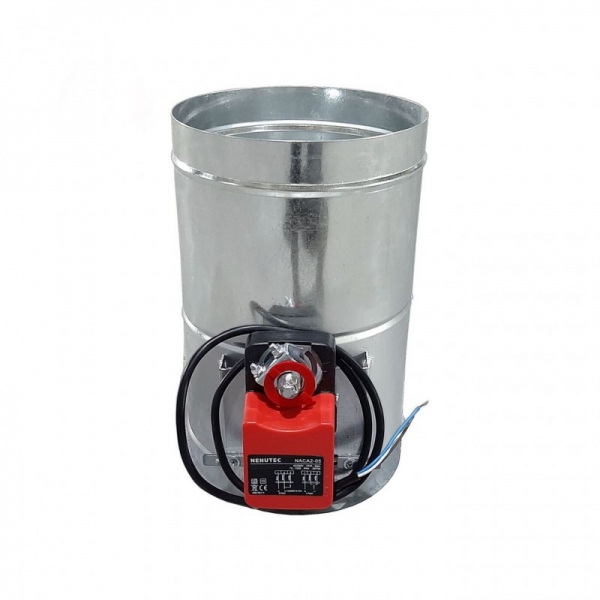
Electric actuator: The most critical component, responsible for opening and closing the blades based on control signals from the central system.
Drive shaft: Connects the actuator to the blades and transmits torque for damper operation.
Control signal interface: Depending on the damper type, control signals may be 0–10V, 4–20mA, or relay on/off.
With a simple yet effective design, motorized dampers are easy to integrate into Building Management Systems (BMS) for precise airflow control by zone.
Common Types of Motorized Dampers
Depending on application requirements and duct design, motorized dampers are classified as follows:
By shape
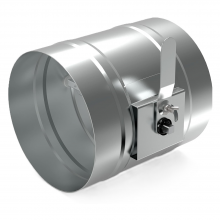
Round motorized damper: Suitable for circular ducts, commonly used in residential and central ventilation systems.
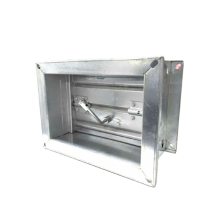
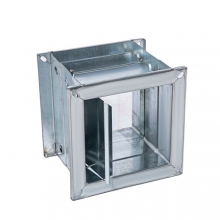
Rectangular motorized damper: Designed for rectangular ducts, widely used in industrial facilities and commercial buildings.
By control function
On/Off damper: Operates in two positions—fully open or fully closed.
Modulating damper: Adjusts blade position proportionally to the control signal, enabling precise airflow regulation.
By installation purpose
Motorized fire damper
Pressure balancing damper
Proper classification helps engineers select the correct damper type for specific HVAC operational and design requirements.
Operating Principle of Motorized Dampers
Motorized dampers operate by converting electrical signals into mechanical motion, allowing precise and flexible blade positioning according to system demand.
Voltage signal control
0–10V or 4–20mA modulating signal: Adjusts blade position proportionally to the input signal (e.g., 5V ≈ 50% open).
On/Off signal: Controls the damper in fully open or fully closed positions, suitable for non-precision applications.
This signal-response mechanism enables synchronization with BMS or PLC systems, optimizing airflow based on temperature, humidity, or indoor air quality conditions.
Role of the Actuator
The actuator is the “heart” of a motorized damper, converting control signals into rotational movement to adjust blade position.
Main actuator types:
Electric actuator: Most common, quiet operation, low power consumption, suitable for precise control.
Modulating actuator with feedback: Provides position feedback to the controller for higher accuracy and safety.
Well-known actuator brands include Belimo, Honeywell, Siemens, and Henutec. Proper actuator selection directly affects system performance, durability, and control accuracy.
Typical HVAC Applications
Motorized dampers are essential components in modern HVAC systems across office buildings, shopping malls, hospitals, and industrial facilities.
Building ventilation systems
Installed in main ducts to distribute airflow across floors or zones.
Used in branch ducts for automatic airflow balancing based on cooling load or occupancy.
Positioned near supply diffusers to control air delivery into specific spaces.
In BMS-controlled systems, dampers can receive signals from CO₂ or temperature sensors to optimize performance and reduce energy consumption.
AHU and FCU systems
AHU: Controls supply/return airflow and maintains stable pressure and temperature.
FCU: Regulates airflow for individual rooms or zones.
Smoke extraction and stair pressurization systems: Automatically open/close according to fire safety scenarios.
Some advanced installations combine motorized dampers with IAQ sensors to optimize indoor air quality.
How to Select the Right Motorized Damper
Proper selection ensures efficient HVAC operation, reduced maintenance, and long-term energy savings.
Key technical considerations
Duct size: Must match duct diameter or dimensions (typically Ø100–Ø600 mm, or rectangular 300×300 to 800×800 mm).
Airflow and pressure: Damper must handle required air velocity without excessive pressure loss.
Control signal type:
0–10V / 4–20mA for BMS and modulating control
On/Off for basic systems
Actuator power supply: Commonly 24VAC/DC or 220VAC.
Fire resistance / air leakage class (if required): For critical areas such as basements or fire-rated zones, minimum 90-minute fire rating may be required.
Material selection: Galvanized steel or stainless steel depending on humidity and environmental conditions.
Round vs. Rectangular Motorized Dampers
| Criteria | Round Damper | Rectangular Damper |
| Suitable duct | Circular (spiral/flexible) | Rectangular/square |
| Installation | Easier in tight spaces | Requires more space |
| Aesthetics | Compact, ceiling-friendly | Typically in technical areas |
| Cost | 10–15% lower | Higher due to larger structure |
| Air tightness | Good for residential | Better for industrial airflow |
Round dampers are typically preferred for residential and office buildings, while rectangular dampers are more suitable for industrial and large commercial systems.
Motorized control dampers provide an optimal solution for modern HVAC systems requiring automation, precision, and energy efficiency. Understanding their construction, operating principles, and selection criteria ensures reliable, stable, and long-lasting system performance.