 100% genuine goods Payment on delivery Nationwide Delivery
Hotline
(+84) 906922412
100% genuine goods Payment on delivery Nationwide Delivery

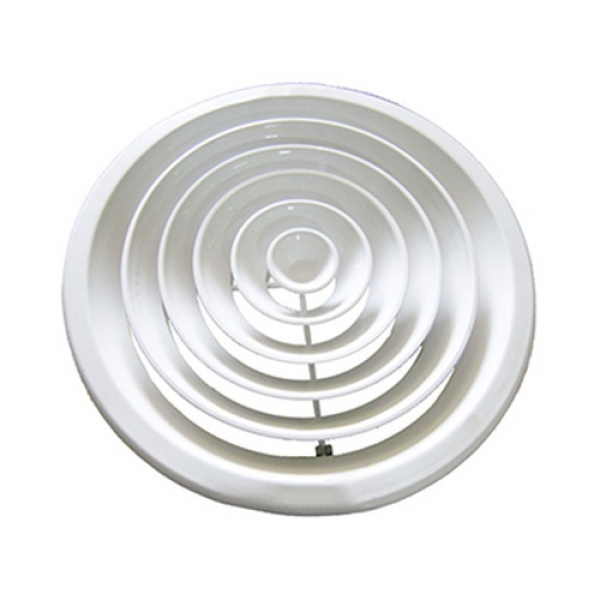

Description:
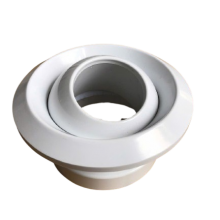
Circular design for optimal 360° air diffusion
Helps regulate airflow and control cool air velocity
Even air distribution without strong drafts
Quiet operation, effective noise reduction
Ideal for high ceilings, factories, and cold storage
Stabilizes pressure, improves energy efficiency
Easy installation, removal, and routine cleaning
Parameter:
| Product code | G-RD |
Not only an air distribution device, the round air diffuser is also a sophisticated technical component in HVAC systems. To ensure optimal air dispersion, its structure and operating principle must be precisely engineered down to every detail.
A standard round air diffuser typically includes the following parts:
Diffuser face: Consists of multiple concentric rings that help direct and evenly distribute airflow.
Neck connection: The section connecting the diffuser to the duct, typically with a diameter from 150 mm to 500 mm.
Airflow control blades (optional): Assist in adjusting airflow direction and volume.
Clips or hinges: Allow easy removal for cleaning and maintenance.
Common materials include powder-coated aluminum or galvanized steel, ensuring corrosion resistance and durability in industrial environments.
The circular structure allows the airflow to spread evenly in a 360-degree radial pattern. This creates a “circular air curtain” effect that covers a wide space.
When high airflow passes through, the concentric rings divide and reduce air velocity at each ring level, producing a gentle and comfortable airflow.
This principle is crucial to avoid cold drafts at a single point while maintaining uniform temperature distribution throughout the space.
Not all air outlets perform effectively in large spaces, high ceilings, or complex HVAC systems. Therefore, round diffusers are widely used thanks to their flexibility, strong diffusion capability, and stable air distribution — something traditional devices struggle to achieve at high airflow rates.
In factories, production workshops, logistics areas, or shopping malls, controlling temperature and air quality is essential. Round diffusers perform exceptionally well due to:
Wide and long air throw, suitable for large spaces with minimal obstruction
Compatibility with high air pressure, meeting industrial ventilation requirements
Reduction of heat accumulation or cold-air dead zones in factories
Additionally, in central HVAC systems, round diffusers easily connect to round or square ducts via transition collars, providing flexibility in ventilation design.
One typical environment requiring round diffusers is high-ceiling areas (from 3.5 m and above). At this height, square diffusers may cause air to “drop quickly,” creating uncomfortable cold drafts below.
Round diffusers, with wide diffusion angles, allow air to spread gently downward. This is why they are commonly used in:
Industrial cold storage
Food processing factories
Exhibition halls with high ceilings
Apartment corridors and shopping centers
In cold storage facilities, round diffusers also help maintain even air circulation, reducing ice buildup or cold-air blockage in hidden areas.
Round diffusers are highly compatible with most HVAC components:
Easy connection with round ducts or flexible spiral ducts
Can be combined with a volume damper for local airflow adjustment
Works well with VRV, VRF, and Chiller central air-conditioning systems
Moreover, the circular face and concentric design make integration with ceiling lighting, interior design, and sensors easier without affecting aesthetics.
Many users wonder why round diffusers are preferred over the more common square type in high-airflow applications. The answer lies in superior diffusion efficiency, pressure distribution, and aerodynamic stability of the circular design.
Thanks to its multi-ring concentric design, the round diffuser divides airflow and distributes it evenly in 360 degrees, which helps:
Reduce air velocity at each outlet point, avoiding direct drafts on occupants
Create a stable air zone without turbulence or local vortex
Evenly distribute cool air to distant or obstructed areas
When airflow increases (e.g., 800–1800 m³/h), this design maintains pressure stability without noise or vibration.
At heights above 3.5–4 m, conventional diffusers often cause air to fall vertically, resulting in concentrated cold airflow and energy loss.
In contrast, round diffusers distribute air evenly from above, creating gradual cooling and preventing temperature imbalance between floor and ceiling.
In facilities such as cinemas, stadiums, and factories, maintaining uniform pressure also helps HVAC systems run more smoothly and efficiently, reducing energy consumption.
Choosing the right round diffuser depends not only on size but also on the operating environment, required airflow, and compatibility with the existing HVAC system. Incorrect selection can significantly reduce ventilation efficiency and cause energy waste or premature failure.
A key factor when selecting a round diffuser is determining required airflow (m³/h) and space area.
| Room Area (m²) | Ceiling Height (m) | Recommended Airflow (m³/h) | Diffuser Diameter |
| 20 – 30 | 2.8 – 3.5 | 400 – 600 | Ø200 – Ø250 |
| 50 – 80 | 3.5 – 4.2 | 800 – 1200 | Ø300 – Ø400 |
| >100 | ≥4.5 | 1500 – 2000 | Ø500 – Ø600 |
Note: Incorrect calculation may result in weak airflow (insufficient cooling) or excessive airflow causing noise and discomfort.
Some frequent technical mistakes include:
Choosing the wrong diameter → pressure imbalance, poor airflow distribution
Ignoring ceiling height → strong drafts or insufficient diffusion
Incorrect placement → airflow blocked or deflected by walls/obstacles
Not using a volume damper → difficult airflow control by zone
To avoid these issues, users should consult HVAC engineers or design consultants before installation.
Round air diffusers are essential in industrial air-conditioning systems requiring high airflow, quiet operation, and uniform air distribution. Understanding their structure, selection, and installation helps optimize HVAC performance, save energy, and reduce operational risks.
If you need an effective air diffusion solution for high-ceiling spaces, round diffusers are a highly recommended choice.