1. What is a round air diffuser?
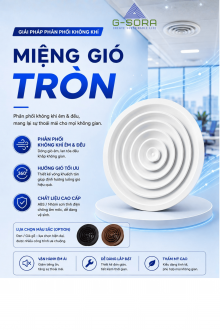
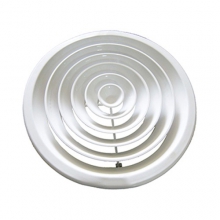
A round air diffuser is an air outlet made of several concentric circular cones fixed firmly together. It is mainly used as a supply outlet, circulating air to keep the space fresh and comfortable – especially suited to busy areas in commercial and service buildings.
A key advantage is the removable core, which makes cleaning, maintenance and airflow adjustment easy. Round diffusers are usually installed in gypsum ceilings, walls or directly on round ductwork.

2. Common types of round diffusers
Round ceiling diffuser
The most common supply diffuser, used to distribute cooled air. It consists of a central disc surrounded by concentric directing rings, discharging air in a conical or multi-directional pattern around its axis.
- Installation: ceiling-recessed or on round ducts
- Applications: shopping malls, office buildings…
- Advantages: even diffusion, attractive, easy to fit in gypsum ceilings
- Option: integrated volume control damper (VCD)
Round return grille
Used to draw return air back to the indoor unit. Simpler in construction – usually concentric slots or perforated mesh with no need to direct the air.
- Installation: ceiling, wall or flexible duct
- Applications: return air in residential and commercial spaces
- Advantages: free-flowing, easy to install, low cost
Round slot diffuser
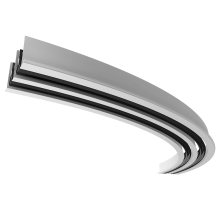
A more modern design with narrow supply slots, often integrated into curved ceilings or distinctive architecture.
- Installation: decorative ceilings or space-limited areas
- Applications: restaurants, hotels, premium shops and showrooms
- Advantages: high aesthetics, minimal lines, precise air distribution
Round diffuser with integrated VCD
Some round diffusers have a VCD fitted directly behind them, allowing technicians to adjust airflow without a separate damper in the duct.
- Applications: rooms needing tight airflow control such as cleanrooms and labs
- Advantages: saves space, easy balancing, fewer accessories
ABS plastic round diffuser (for humid environments)
Made from ABS or engineering plastic, this type is ideal for high-humidity areas such as toilets, bathrooms, plant areas and water treatment zones, and for air-conditioned spaces where condensation must be avoided.
- Advantages: corrosion-free, rust-free, easy to clean, low condensation
- Limitations: not suitable for high temperatures or heavy loads
See the ABS plastic round ceiling diffuser.

3. How to tell round diffusers apart
By function
- Supply: distributes cooled air from the AC system; usually has a diffusing design for even spread.
- Return: draws warm room air back to the indoor unit; simpler, with no need to direct air.
By airflow
- Low (≤300 m³/h): small Ø150–Ø200, for toilets, single rooms and corridors.
- Medium (300–1,000 m³/h): Ø250–Ø350, common in offices and meeting rooms.
- High (≥1,000 m³/h): Ø400 and above, or several smaller diffusers combined.
By installation type
- Ceiling-recessed: attractive diffusers widely used in offices and showrooms.
- On flexible duct: easy to install and reposition, often used in ancillary areas.
- Exposed or suspended: for factories, cold stores and plant spaces.
By material
- Powder-coated aluminium: light, durable, corrosion-resistant – the most common.
- Galvanised steel: mechanically strong, lower cost.
- ABS plastic: moisture-resistant and light, for toilets, bathrooms and humid areas.

4. Choosing the right round diffuser
Choose based not only on shape or price but on technical factors related to HVAC operation and the specific space.
By AC capacity and airflow
Each AC capacity corresponds to a standard supply or return airflow. The diffuser free area must be large enough to distribute air evenly without excessive pressure or overly strong jets.
- 1–2 HP: Ø200–Ø300 round diffuser
- 3–5 HP: Ø350–Ø450
- Larger capacities: several diffusers or custom sizes to drawings
Noise requirements
In work, rest and premium spaces, noise must be controlled. A small diffuser produces strong jets that can whistle or hum. If NC < 30 is required:
- Increase the diffuser diameter
- Reduce discharge velocity
- Use multi-cone diffusers or acoustic lining
Actual installation location
- Gypsum or closed ceilings: ceiling-recessed diffusers
- Plant spaces or exposed ceilings: duct-mounted or suspended types
- Wall returns: simple, easy-to-remove round grilles
- Round flexible duct: direct-mounted diffusers or diffusers with a neck
Avoid installing diffusers too close to heat sources (high-power lights) or obstructions (beams, recessed LEDs).
Aesthetics and interior coordination
- The soft round shape suits modern styles
- Can be painted to match the ceiling
- Choose diameters that match round light fittings for a balanced look
Do you need a volume control damper (VCD)?
A VCD regulates airflow through each branch or diffuser. If each zone needs precise balancing, choose a round diffuser with an integrated VCD:
- Easier system balancing
- Less reliance on the main damper
- Convenient for maintenance or seasonal adjustment
If airflow is already controlled by a main damper or a VAV/CAV system, the diffuser may not need a VCD, saving cost.

Need help choosing round diffusers? Contact G-SORA for technical advice and a quotation.

 100% genuine goods