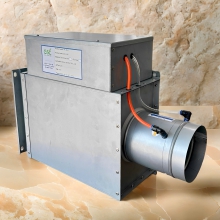
1. Overview of round manual dampers
What is a round damper?
A round damper has a circular cross-section and is installed in round ductwork. It is popular for its compact design and easy installation, suitable for both supply and return ventilation.
A simple mechanical lever control
The hand lever (locking quadrant) lets users set the blade angle to increase or reduce airflow. It needs no power and works entirely manually, keeping costs low.

2. Key advantages
- Simple design, easy installation: fits straight into round ducts without complex accessories.
- No power supply needed: fewer electrical faults and lower operating costs.
- Easy maintenance: no special skills needed to inspect or replace.
- Low cost: suits the budgets of small and medium projects.
- Flexible adjustment: airflow is adjusted by hand on site, with no remote controls required.
3. Which projects should use round manual dampers?
Residential buildings (houses, small apartment blocks)
For regulating air in kitchens, living rooms and laundry areas – chosen for low cost and no need for complex controls.
Small and medium offices
Easy to install on secondary branches of central AC systems so each office can adjust its own airflow.
Medium-sized factories
In industrial ventilation or dust extraction, they adjust each branch to production needs.
Schools, classrooms and basic laboratories
Where precise temperature control is not required, they are a good way to balance airflow between rooms.
Local extraction and ventilation
Kitchen extract ducts, toilet exhaust and roof ventilation.
4. When not to use manual dampers
- Systems needing automatic or remote control (e.g. via BMS or sensors)
- Technically demanding projects: hospitals, data centres, cleanrooms
- Locations adjusted frequently, where levers can wear or loosen over time
5. Quick comparison with other dampers
| Criteria |
Round manual damper |
Motorised damper |
Backdraft damper |
Pressure relief damper |
| Control |
Manual |
Automatic |
Self-acting (pressure) |
Self-acting (pressure) |
| Cost |
Low |
Higher |
Medium |
Medium |
| Applications |
Homes, offices |
Large modern projects |
Extract ducts |
Cleanrooms |
| Easy to install |
✅ |
❌ |
✅ |
✅ |
| Adjustment accuracy |
Medium |
High |
Not adjustable |
Not adjustable |
6. Installation and maintenance tips
Installation
- Choose the right position: where the lever is easy to reach for inspection and adjustment.
- Fit tightly to the duct: seal joints with sealant or proper clamps.
- Check after installation: move the lever to confirm smooth operation and blade sealing.
Maintenance
- Every 3–6 months: remove dust and check the lever pivot.
- Every 12 months: dismantle to clean the blade and lubricate if needed.
- Avoid excessive force: to prevent bending the shaft or breaking the lever.

7. Pros and cons
Pros: simple installation without electrics; low cost and easy replacement; flexible adjustment for small projects.
Cons: no BMS connection or remote control; not suited to technically demanding projects; less precise than motorised dampers.
8. Real-world applications
- Suburban primary schools needing basic, easy-to-maintain ventilation
- Small logistics warehouses that need fresh air at low initial cost
- Rental housing and homestays where owners want a quick, effective solution
This flexibility makes manual dampers an optimal choice for small and medium projects while still delivering effective ventilation and savings.
9. Buying tips
- Material: galvanised steel, stainless steel or aluminium for durability and rust resistance in humid environments.
- Correct size: match the duct diameter for a tight connection without leaks.
- Reputable brand: experienced HVAC suppliers ensure fabrication quality.
- Warranty: check warranty terms and technical support for installation and maintenance.
- Frequency of use: if adjusted often, consider a worm-gear or motorised damper for longer life.
10. The role of round manual dampers in the overall HVAC system
- Zone airflow regulation: balances air between rooms for uniform temperature and ventilation.
- Supports main equipment: limiting airflow on secondary branches keeps fans and central AC from overloading.
- Manual control: useful for quick local intervention, e.g. during power outages.
- Lower energy losses: closing unused branches saves fan and cooling energy.
- Stable duct pressure: correct settings prevent air build-up or abnormal pressure drops.
The round manual damper is an effective choice for homes, small factories and offices that do not need automatic control but want low cost and easy operation. Contact G-SORA for HVAC air distribution advice.

 100% genuine goods